Showing posts with label publishing industry. Show all posts

Friday, December 13, 2013

Self-Publishing: Debating the numbers.


A while ago I did a post on book sales from both traditionally published authors and self-published authors (or as I like to say Indie authors). Most of my figures a few years old, because the publishing industry isn't very forthcoming about its sales figures. 


Well, my friends, it seems like I’m not the only person who’s been wondering how Indie authors fair compared to their traditional counter parts.  Dana Beth Weinberg did a series of articles entitled The Self-Publishing Debate.  In the three parts she talks about all the usual issues: Why self-pub/traditional pub? How many titles do self-pub/Traditional/Hybrid authors publish? What kind of income do they make?

Her analysis is based on the 2013 Digital Book World and Writer’s Digest Author Survey; that surveyed 5,000 authors. Not nearly a complete look, but a nice sample.


Here are some of the highlights from her report:

About 19% of self-published authors in the sample also reported no annual income from their writing, compared to 6% of traditionally published authors and only 3% of hybrid authors.

(At the top earning, $200,000) less than one percent (0.6%) of self-published authors, 4.5% of traditionally published authors, and 6.7% of hybrid authors who reported on their income.

Self-published authors in the sample earned a median income in the range of $1 to $4,999, while traditionally published authors had a median writing income of $5,000 to $9,999, and hybrid authors earned a median income of $15,000 to $19,999.

Digital Book World’s analysis created a bit of a stir in the Indie publishing world. Especially when a colleague promoted her post on Forbes with the following title: How Much Money Do Self-Published Authors Make? And to answer that question he stated: In short, not much.


Indie authors from all over the web came out to cry foul.  What were their issues?  

Who they sampled for starters. Many active indie authors (who claim to be high earners) said they weren't asked take part in the survey despite being affiliated with Writer’s Digest. When you do informal surveys like this it’s hard to get a repressive data set. Is it likely they missed the mid-level and higher earners because they were busy working on their careers? Yes.

One comment mention that there was no distinction between new authors (with only a few books under their belt) and authors who've been publishing for years.  Time is an important factor in building an audience. So there’s a higher likelihood that the traditionally published/hybrid authors in the survey have an advantage over the indie authors because self-publishing is still in its infancy.

The other issue that I think is more than fair was broached by Hugh Howey. He complains that the survey is reading the data wrong. He argues:

But that compares ALL self-published authors and only a small fraction of people who go the traditional route. I've been hammering this point home for years, but it still gets left out of these comparisons. When you look at earnings and sales figures for traditionally published books, you have to take into account the huge percentage of books that never make it out of the slush pile. Why? Because those are authors and books attempting to go that route.


He makes a good point. Look at it this way.

If I've written a book and am trying to publish through the big five publishers, I spend my time submitting my work, tweaking it, and resubmitting it.  Sometimes for years. If my own writing contacts are indicative of this route then it’s likely these authors have several unpublished books waiting in the wings for a publisher to give them a golden ticket. None of these writers are counted on as traditionally published authors that have no income from their writing. Because the survey is looking at PUBLISHED writers.


BUT on the other spectrum. I write that same book, prepare it for self-publication, and despite my blood offerings to the gods of Indie authors, I don’t sell a single copy.  I’m counted in the survey as making no income on the book because I've published.

One of the main problems and greatest advantages to self-publishing is there are no gatekeepers.  No one stops you from publishing a book of poetry about your cat mittens. No one tells you that caveman erotica won’t sell. You can publish what you want (within the distributor’s guidelines).  


So Howey has a point. If we are counting the multitude of authors who self-publish (even when they shouldn't) why aren't we counting the publishing slush pile? 

Personally I like the landscape Howey paints for the self-publishing industry:

Even if you just guessed at the number of [traditionally] submitted manuscripts that make it to publication being at 1% (which I think is awfully generous), you would immediately see a completely different landscape. Take the top 1% of self-published books and compare their earnings with traditionally published books. That would be something to behold.

While I think he’s being a little too generous there, but he could be right. Amazon recently reported that 25% of their digital best sellers (top 100 kindle books) for last year were indie titles. That is something to behold!

Friday, October 18, 2013

Publishing Industry Facts That Will Make You Think

I've been MIA for longer than intended, but it's a good thing.  I've been busy writing. The finish line for Lotus Petals is in sight!!!

This week I was asked to host a discussion about self publishing and small press publishing for my writers group.  I've spent the week researching and putting together information and I wanted to share with my readers. :)  This will be a multipart post (I went overboard on the research!!)


THE HEALTH OF THE PUBLISHING INDUSTRY:

Despite the go-go of our society and the multitude of entertainment options we have today, PEOPLE ARE STILL READING, but how they are reading is changing.


Sales of hardcovers rose 1.3% in the year, to $5.06 billion, and trade paperback sales increased slightly, up 0.4%, to $4.96 billion. . . . Total e-book sales rose 44.2% in 2012, to $3.04 billion and accounted for 20% of trade revenue and sales of downloadable audio rose 21.8% in 2012, to $240.7 million. (figures from Book stats)

The number of traditionally published print books rose 6% in 2011, to 347,178, according to preliminary figures released by Bowker.  This was the first year they included self-published titles in the 'traditionally published' column , and they believe this was the driving factor to the increase.

Bowker goes on to say that the number of self-published books has tripled in growth, especially in ebooks.  They tally more than 235,000 new print and ebooks in 2011. This can easily be contributed to new technology that makes self-publishing so easy.  And the news of self-published authors 'making it big'. Even with the superstars of self published books being heralded as modern day folk heroes of the publishing industry, individual self published books usually don't do well.

According to the New York Times: “most self-published books sell fewer than 100 or 150 copies", many authors and self-publishing company executives say.


There are breakout successes, to be sure, and some writers can make money simply by selling their e-books at low prices. Some self-published books attract so much attention that a traditional publishing house eventually picks them up. But It's not an easy path to follow, you have to be an entrepreneur if you're planning to self publish.

"So I'm going to push hard to get a publishing contract," You say. "That way I'll be successful in selling my book!"


Well not so fast. Publishing contracts don't guarantee success.  As a matter of fact, MOST BOOKS don't do well regardless of who or how they are published.
"Here's the reality of the book industry: in 2004, 950,000 titles out of the 1.2 million tracked by Nielsen Bookscan* sold fewer than 99 copies. Another 200,000 sold fewer than 1,000 copies. Only 25,000 sold more than 5,000 copies. The average book in America sells about 500 copies. Those blockbusters are a minute anomaly: only 10 books sold more than a million copies last year, and fewer than 500 sold more than 100,000.(Publishers Weekly, July 17, 2006). 

And Nonfiction fairs even worse. According to BookScan*, which tracks most bookstore, online, and other retail sales of books, only 299 million books were sold in 2008 in the U.S. in all adult nonfiction categories combined. The average U.S. book is now [2011] selling less than 250 copies per year and less than 3,000 copies over its lifetime.
*A note about bookscan. They only track books with ISBN numbers. A lot of Digital only self-published novels are forgoing the expense of ISBN, and there’s no data on their sales from the industry.

LET ME STRESS THAT:
 500 COPIES PER YEAR!

 
Which means for every book that sells over a million copies there are thousands that are complete flops.

Yes, these aren't the most current statistics, but sales figures on individual books are guarded. The publishing houses don't talk about it. Published authors, who are ordinarily helpful and supportive of new writers, guard their numbers and don't talk shop. Agents are closed lipped about it.

Smashwords, a self-publishing website has been fairly open about individual book sales. “We make it clear to our authors.” That a huge majority of self-published books “don’t sell a lot of copies,” said Mark Coker, the founder and chief executive of Smashwords, a no-frills operation that concentrates on self-published e-books.


This graph represents Smashword books only.


 THE DIGITAL DIVED: Will Digital books save the publishing industry?


E-book sales have increase dramatically. Looking from January 2011 to January 2012, the increase was 49.5% for adult books and 475.1% for children and YA books. One analyst from Simba Information estimated that 1 in every 5 adults is reading e-books on a digital device.

Book Sales (as of second quarter 2012)
30% Trade Paperback
27% Hardcover
22% E-book
12% Mass-market
7% Other bindings
2% Audio Book

Pricewaterhouse Cooper projects that by 2016, e-books will make up 50% of the U.S. book market, and that physical book sales will hold steady with only slight percentage increases from year to year.

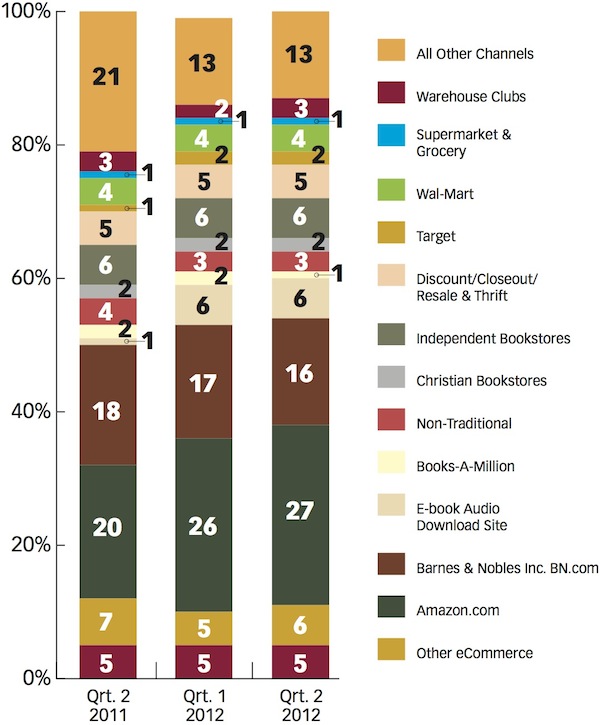
Market Share of Book Sales (as of second quarter 2012)
27% Amazon
16% Barnes & Noble and B&N.com
6% Audio E-book websites
6% Other E-commerce
6% Independent Bookstores
5% Resale and Thrift
4% Walmart
3% Warehouse Clubs
2% Target
1% Books-a-million
1% Supermarket and Grocery
13% All Other Channels

E-book Sales (as of second quarter 2012)
62% Amazon
22% Barnes and Noble
10% Apple
2% Sony
1% Kobo
~3% Google and others

The publishing industry isn't blind to these statistics. A Digital Book World survey found that at the end of 2011, 82% of publishing executives surveyed were optimistic about the transition to digital formats and 54% projected the decline of sales for printed books.

So with the ease of self publishing and the demand for digital books rising, the next ten years will be an exciting ride in the publishing industry.

Tune in for part two where I muse on how an author can possible making money in this brave new world of publishing.